01 — AI Legal Technology
InFactIQ + Lexitas
Designing clearer, more intuitive workflows for an AI-assisted legal platform used by lawyers and paralegals.
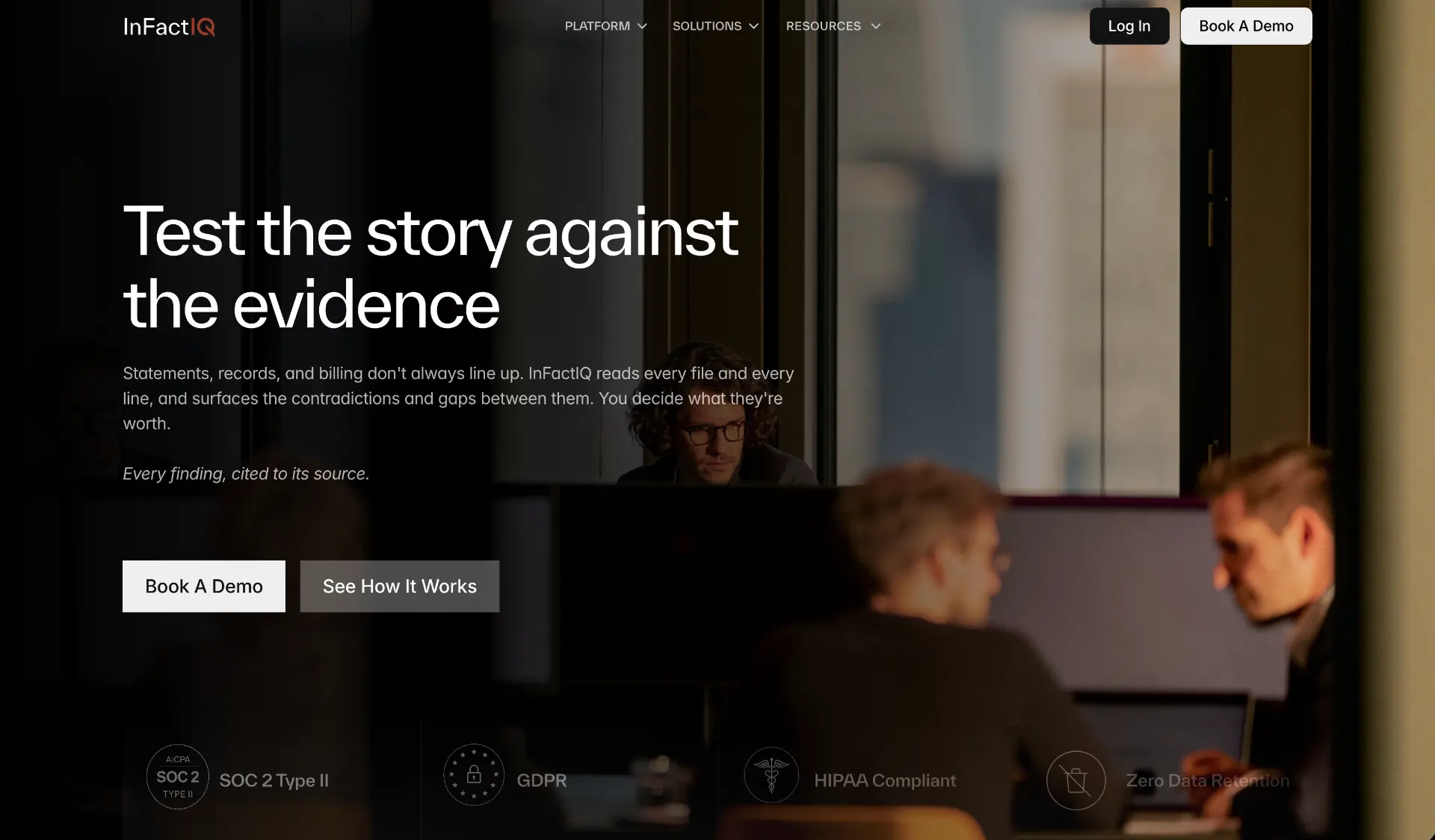
InFactIQ website screenshot — provided by Beatriz Paiva.
01 — Overview
An AI-assisted legal platform where lawyers and paralegals review depositions, evidence and case material. The design work focused on making AI output legible, verifiable and usable inside real legal workflows.
02 — Context
Legal teams work under time pressure and strict standards of accuracy. Any AI assistance has to be traceable back to the source material, or it will not be trusted or adopted.
03 — The Challenge
Lawyers and paralegals needed faster, more reliable workflows inside an AI-assisted legal platform.
04 — My Role
Product Designer, embedded with AI development teams and legal-industry stakeholders.
05 — Discovery / Research
The challenge was not simply to make AI output easier to read, but to understand how legal professionals actually work with AI in time-sensitive situations. I mapped the existing legal workflows, identified where users needed to review, verify, or act on AI-generated information, and worked closely with AI development teams and legal-industry stakeholders to understand the constraints behind the product. This helped define where AI could accelerate the workflow and where human judgement needed to remain central.
06 — Key Insights
AI can accelerate a workflow, but it cannot remove the need for human judgement. Legal professionals need to understand where information comes from, what the system has generated, and what they can confidently act on. The interface therefore had to make AI-assisted output not only accessible, but legible, verifiable and actionable.
07 — Design Approach
I focused on designing AI-assisted workflows that keep people in control. That meant making generated information easy to understand, surfacing relevant sources alongside AI output, and creating clear states for uncertainty, review and decision-making. The goal was not to hide the complexity of AI, but to make that complexity easier for professionals to navigate.
08 — Key Design Decisions
01 — Keep the human in the loop Designed workflows where AI supports professional judgement rather than replacing it. 02 — Make AI output verifiable Structured information so users could understand and assess generated results before acting on them. 03 — Reduce cognitive load Simplified complex legal workflows into clearer steps, states and interactions. 04 — Design for uncertainty Made room for review, confidence and ambiguity instead of presenting AI output as unquestionable fact. 05 — Work within the existing product ecosystem Designed alongside engineering constraints and existing workflows rather than treating the interface as an isolated visual layer.
09 — Final Solution
The final experience brought AI assistance into the existing legal workflow without making the technology feel like a separate layer. Information was structured around the decisions users needed to make, with AI-assisted output presented in a way that could be reviewed, understood and acted upon. The result was a more intuitive workflow for lawyers and paralegals using the platform in their day-to-day work.
10 — Outcome
The work helped turn complex AI-assisted legal processes into clearer, more usable product experiences. By making AI-generated information easier to understand and verify, the platform could support legal professionals without removing the human judgement required in their work. The result was a workflow designed around clarity, efficiency and trust.
11 — Learnings
Designing AI products changed the way I think about simplicity. In traditional product design, reducing complexity often means hiding unnecessary information. In AI-assisted products, some complexity needs to remain visible so users can understand what the system knows, what it generated, and where they need to make the final judgement. I learned that designing for AI is not only about making interactions efficient. It is about designing appropriate levels of transparency, control and trust.
Next Project →
Design System — Siemens